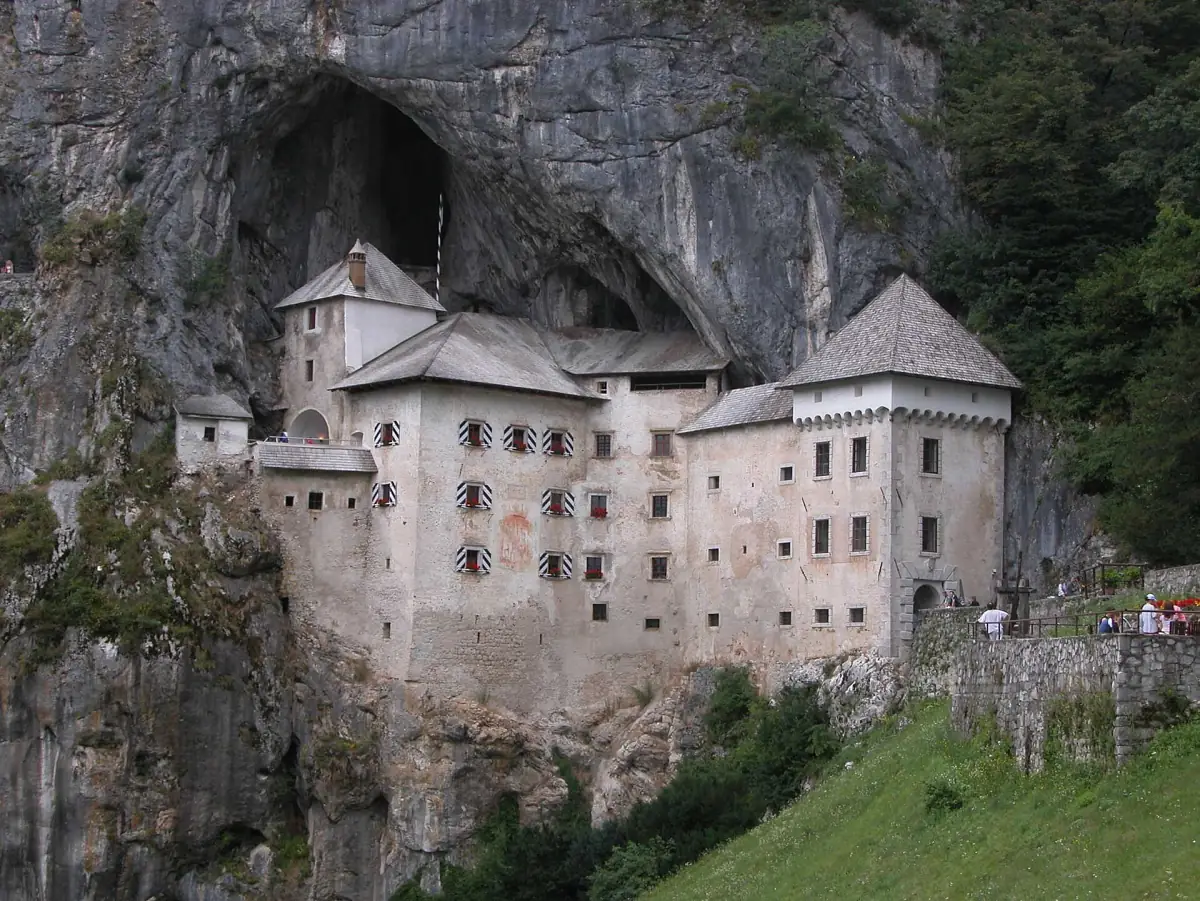
Predjama Castle history before Erazem
Predjama Castle history begins before the famous stories of siege and betrayal. The castle was probably founded in the 12th century and first appears in writing in 1274 under the name Luegg. Its early setting was the territory of the patriarchs of Aquileia. The distinction between a probable foundation period and a first written mention matters: the surviving building should not be treated as a structure completed in a single known year.
The castle also changed after its medieval beginnings. Its present appearance owes much to Renaissance rebuilding, while older parts belong to earlier phases. Reading the site chronologically helps separate its origins from the façade seen today. The guide to the castle interior looks more closely at the rooms and architectural elements; here the focus is on the people, changes in ownership and stories attached to the building over time.
The medieval palas and later entrance tower belong to that longer development. They are useful reminders that a castle can preserve earlier fabric while taking on a different appearance. Rather than assigning everything visible to Erazem’s lifetime, keep the sequence in mind: medieval foundation, later rebuilding, subsequent owners and finally museum use. Each stage contributes to what visitors encounter now.

Erazem Lueger and the siege
Erazem Predjamski, also known as Erazem Lueger or Luger, was a 15th-century nobleman associated with the Carniolan and Gorizian world. The historical framework places him in conflict with the Habsburgs. He succeeded as lord of the castle in 1478 and died during the siege in 1484. Those points provide a firmer chronological frame than the dramatic details usually attached to his final days.
The familiar account of his conflict beginning with the killing of Pappenheim after an insult to a friend belongs to legend. The distinction is especially useful before visiting: the historical Erazem and the hero of later storytelling are related subjects, but not interchangeable ones. An account written much later can show how his reputation developed without serving as an eyewitness record of the siege.
Visit the castle exhibition
This guided trip includes castle admission for exploring the exhibition.
Hand-picked tours, booked through Viator. Prices are indicative starting prices in euros (as of October 2026). Tap a tour for live availability and the current price in your currency.


Photos – Castle and cave trip with guide: Crop of a photo by Lettkemann – CC BY-SA 4.0

See the castle exhibition on a half-day outing
Valvasor and the later legends
The dramatic siege stories are linked to Valvasor’s much later account of 1689. Tales of supplies reaching the castle through hidden routes belong to this tradition, rather than a precise reconstruction of how each day of the siege unfolded. They help explain the castle’s enduring appeal, particularly its image as a fortress sustained by the rock and caves around it.
The story of a servant betraying Erazem and a cannon shot killing him while he used the toilet is also a legend. It should be heard as a dramatic ending to the tale, rather than proof of an exact death scene that visitors can identify. Keeping the story in that category lets its memorable details remain part of the visit without turning them into established evidence.
A further local legend places Erazem’s grave beneath the lime tree by the neighbouring church and says that his beloved planted the tree. This is a tradition about the place, rather than an identified burial. The church and tree belong to the wider setting of the story, but the legend should not become a claim that the grave has been found. Nor does the tale establish a precise duration for the siege.
The Cobenzl rebuilding and the date 1570
After the medieval period, the Kobencl or Cobenzl family acquired the castle in the 16th century. Rebuilding under their ownership gave it the Renaissance character associated with the present structure. The Cobenzl coat of arms on the façade carries the date 1570. This is a concrete detail to place alongside the earlier written mention, showing how widely separated the castle’s historical layers are.
The Renaissance phase came after Erazem’s death. Remembering that order changes how the building is read: the present façade is not simply the unchanged backdrop to the siege legend. It also represents later owners and their investment in the site. For a visit focused on chronology, the coat of arms provides a useful link between a named family, a date and the visible castle.
Later ownership and the museum
Weriand Windischgrätz acquired the castle in 1846. It remained in family ownership until 1945, after which nationalisation and museum use followed. These later chapters take the story beyond medieval conflict and Renaissance rebuilding. They explain why the visit today involves an exhibition as well as a historic structure, and why objects associated with later ownership belong within the castle’s presentation.
Use the ticket guide for admission and the excursion comparison for ways to visit. The half-day outing includes an air-conditioned vehicle, a panoramic drive, an English-speaking guide and entrance to Postojna Cave and Predjama Castle. It is a way to reach the exhibition, while the history of the castle itself remains the subject of this page.
Questions about the castle’s past
When was Predjama Castle first mentioned?
The first written mention dates to 1274, under the name Luegg. Its foundation probably belongs to the 12th century.
When did Erazem die?
The historical chronology places his death during the siege in 1484. The toilet and betrayal story is a later legend.
What does the date 1570 refer to?
It appears with the Cobenzl coat of arms on the façade and belongs to the castle’s Renaissance history.
Is the grave beneath the lime tree established?
The burial beneath the tree and its planting by Erazem’s beloved belong to local legend.