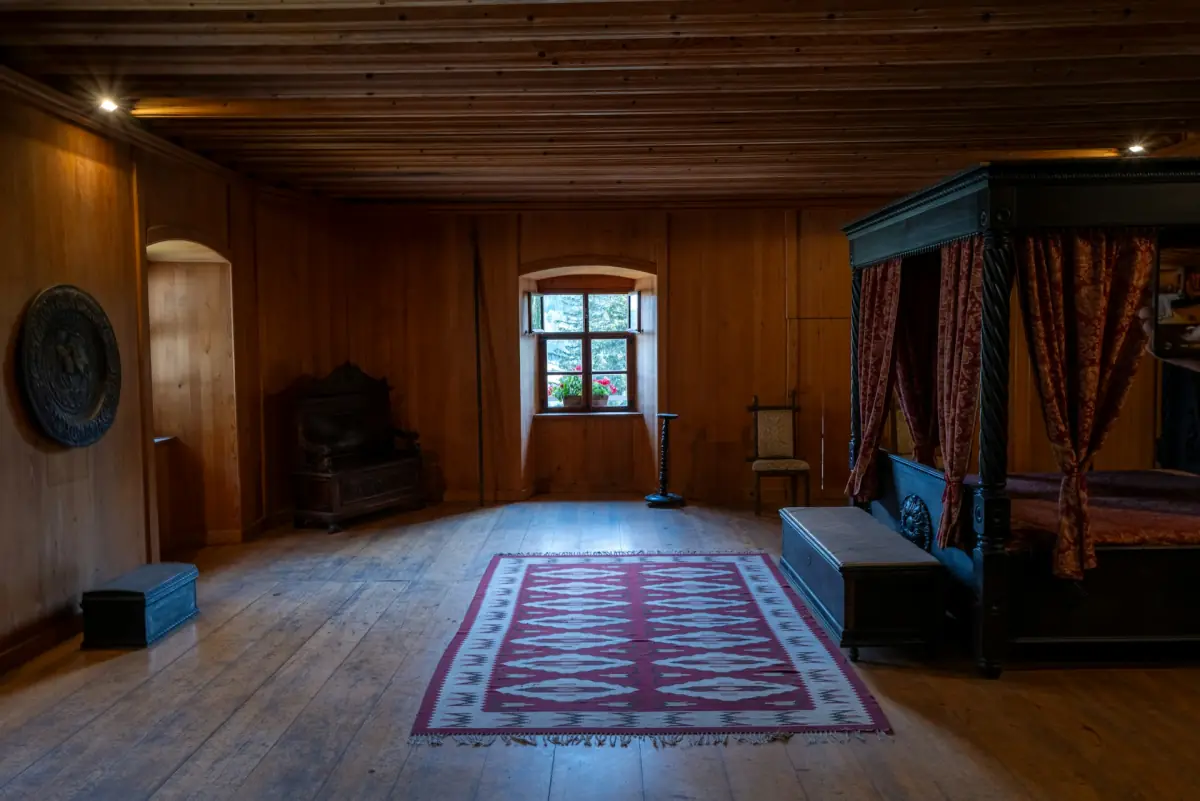
What to see inside Predjama Castle
Going inside Predjama Castle changes the focus from its dramatic façade to the relationship between rooms, rock and fortification. The castle stands immediately before a karst cave in the village of Predjama, in Slovenia’s municipality of Postojna. Natural cavities formed part of its defensive system. A visit therefore brings together a historic building and the landscape into which it was fitted, rather than a collection of rooms detached from their setting.
The interior includes a knight’s room, a late Gothic dining room and a Renaissance hall containing hunting trophies belonging to the last owner. These give the visit several different points of interest: furnished spaces, objects on display and the building around them. Allow time to look at all three. The castle history explains why medieval beginnings and a Renaissance appearance belong to different chapters of the same place.
The dining room is a useful starting point for thinking about the interior as a lived space. Furniture and the surrounding architecture draw attention to different aspects of the room. Looking at how the space is arranged is more rewarding than treating every object as an isolated relic. The exhibition combines original items, reproductions and models, so the distinction between a historic room and its present display matters throughout the visit.

Architecture and historic buildings within the castle
The medieval residential block, or palas, has a Romanesque ground floor. The entrance tower belongs to the Renaissance. These elements help explain why the castle should be read as a building developed in phases. Its present Renaissance form is associated with rebuilding under the Cobenzl family, while the older residential core carries an earlier architectural story. The rock is part of that reading, alongside masonry and enclosed rooms.
Consider the furnished rooms and structural elements together. A room’s exhibition may illustrate life in the castle, while the palas and entrance tower show how the building itself developed. This is the central architectural interest of the interior visit. The connection between the rooms, natural cavities and built defences is what makes the castle distinctive.
A trip with castle admission
This longer trip includes castle entry and a Piran walking tour.
Hand-picked tours, booked through Viator. Prices are indicative starting prices in euros (as of October 2026). Tap a tour for live availability and the current price in your currency.


Photos – Castle, cave and Piran trip: Near Predjama Castle (14200973904) – Crop of a photo by Gord Webster from Victoria, Canada – CC BY-SA 2.0

Visit the castle interior on a day trip
Exhibition objects: originals, reproductions and models
The display mixes original objects with reproductions and models. A furnished room should therefore not be described as an untouched medieval household. The knight’s room, dining room and hunting trophies offer different ways into the castle’s past, but they do not all represent the same period. Treating them as a museum presentation makes the changes in ownership and use easier to understand.
The Renaissance hall’s hunting trophies are associated with the last owner. That connection gives the exhibition a later layer alongside its medieval themes. Visitors interested mainly in medieval life can still look beyond that period: the interior is also a record of subsequent owners and the castle’s eventual use as a museum. The value of entering is in seeing these layers together, rather than expecting every object to come from the age of Erazem.
Use the audio app for the castle walk
The admission includes an audio app in 19 languages, including English and German. A separate loan device is available for an additional charge; the ticket guide explains the distinction. Choose between using the included app and hiring a device when planning how to follow the interpretation. An app-led visit gives you recorded commentary while exploring the castle.
An organised excursion can include castle admission without providing a personal guide through every room. The excursion with Piran includes admission to both the castle and Postojna Cave, an air-conditioned vehicle and a walking tour in Piran. Those inclusions describe a multi-stop outing. For other departure patterns, see the day-trip comparison; for the rooms themselves, the castle’s audio app remains the relevant form of interpretation.
Stairs and the separate underground visit
Many stairs are part of the castle route. The operator describes the interior as unsuitable for wheelchairs, pushchairs and people with severe mobility limitations. Dogs and other pets are not allowed inside the castle. Consider that before making the interior the centre of your day. A shorter stop does not remove the stairs, and the access arrangements of other attractions in the Postojna park should not be applied to this building.
The cave beneath the castle is a separate guided visit, outside the normal castle tour. Seeing rock and natural cavities as part of the building does not mean that the full cave system is included in admission. Read the Predjama Cave guide for its visitor route, seasonal bat-related pause and suitability. Keep the two activities separate when deciding what you want to see.
Questions about the castle interior
Which rooms can I see?
The visit includes the knight’s room, late Gothic dining room and Renaissance hall with hunting trophies belonging to the last owner.
Is a personal castle guide included?
Standard admission includes the audio app in 19 languages. A personal guide through the rooms is a different service.
Can I take a pushchair inside?
The castle route has many stairs and is unsuitable for pushchairs and wheelchairs.
Does the interior ticket cover the cave underneath?
The cave beneath Predjama is a separate guided visit and is outside the normal castle tour.